
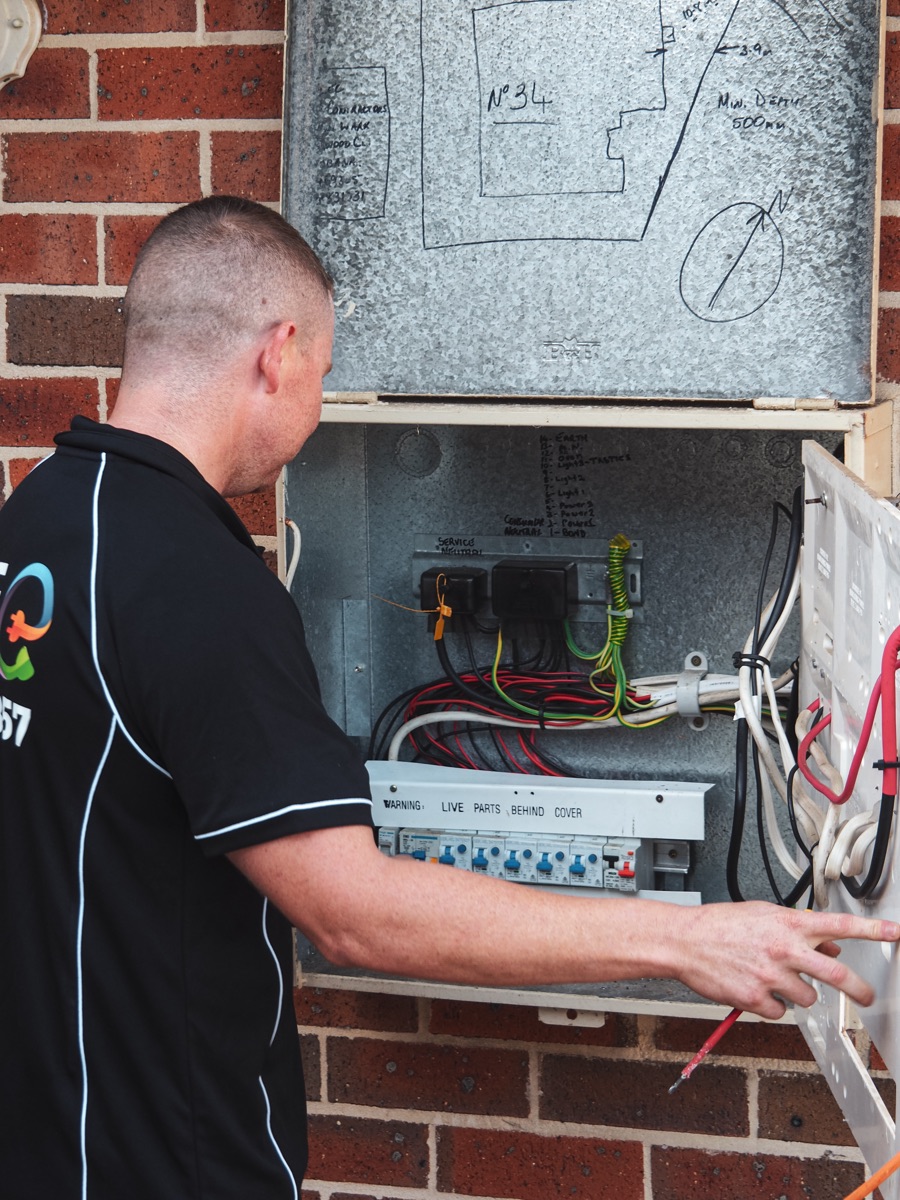
Open your switchboard and you’ll see a row of switches, and most people have no idea which does what. Two of them get mixed up constantly: the circuit breaker and the safety switch. They sound similar and they live side by side, but they do completely different jobs — and knowing the difference genuinely matters for your family’s safety. Here’s the plain-English version from a Newcastle sparky.
The core difference: property vs people
This is the one thing to take away. A circuit breaker protects the wiring in your walls. If a circuit draws too much current — an overload, or a dead short — the breaker trips and cuts the power before the cable can overheat and become a fire risk. It’s there to stop your wiring cooking itself.
A safety switch — also called an RCD (residual current device) — protects people. It constantly watches the current flowing out and the current flowing back. If even a small amount starts leaking to earth — for example, through a person who’s touched something live — it cuts the power in around 30 milliseconds. That’s fast enough to save you from a fatal shock. A circuit breaker won’t do that; the amount of current that can kill a person is far too small to trip a breaker.
What about an RCBO?
You’ll sometimes hear the term RCBO, and it’s a good one to know. An RCBO is a single device that does both jobs at once — it protects the wiring like a circuit breaker and protects people like a safety switch, all on the one circuit. In modern boards we often fit RCBOs per circuit, so that if one circuit has a fault it trips on its own without knocking out the whole house. It’s a tidy, reliable way to do things.
Why a board can have breakers but no safety switches
Here’s the dangerous gap we see all the time in older Newcastle homes. Plenty of switchboards have a full row of circuit breakers but no safety switch at all. That means the wiring is protected — but the people in the house aren’t. If someone contacts a live part — a damaged appliance cord, a dodgy power point, a garden tool that’s let water in — there’s nothing there to cut the power fast enough to prevent a serious or fatal shock.
A lot of homeowners look at a board full of switches and assume they’re covered. If your board is older and has never been upgraded, there’s a real chance you’ve got breakers doing their job and no shock protection at all. It’s worth having a look.
What the NSW rules say (plainly)
Keeping it simple: safety switches are generally required on power and lighting circuits in newer and renovated homes, and they’re strongly recommended on every circuit in any home regardless of age. If you’re renovating, adding circuits, or upgrading the board, that’s the natural time to bring the shock protection up to current standard. Even if your older home isn’t legally forced to have them everywhere, fitting them is one of the cheapest bits of peace of mind you can buy.
Why a safety switch “keeps tripping”
If your safety switch trips and you have to reset it, the instinct is to be annoyed at the switch — but usually it’s doing exactly its job. It’s detected a genuine current leak somewhere, and it’s better it trips than lets that current flow. The two most common causes are:
- A faulty appliance. Something with a deteriorating element or damaged cord — often a kettle, toaster, iron, heater or an old fridge — leaking a little current to earth. Unplug appliances one at a time and you can often find the culprit.
- Moisture. Water getting into an outdoor power point, a light fitting, or a circuit after heavy rain is a classic Newcastle cause — especially in older weatherboard homes.
When to call an electrician: if the switch trips and won’t reset at all, if it keeps tripping even with everything unplugged, or if you can’t track down which appliance is causing it, that’s the point to get a licensed sparky in. It might be a wiring fault rather than an appliance, and that needs testing properly rather than guessing.
Not sure what’s in your board?
If you’ve got an older switchboard and you’re not sure whether you’ve actually got safety switches or just breakers, it’s a quick thing for us to check — and an easy fix if you’re missing them. We’re Ben Stokes Electrical, a small local crew based in Jesmond covering Newcastle and Lake Macquarie, fully insured and working under NSW licence 477240C. Give us a call on 0422 174 357 and we’ll make sure your family’s properly protected.